
Hi, I'm Grady, and I lead strategy at Softly. I've been running a lot of designer interviews lately, and one conversation really stuck with me.
"Why did you design this product detail page in your portfolio the way you did?"
"...Because it looks pretty."
"Okay, it is pretty, but
could I ask what your standard for 'pretty' is?"
"..."
On the other hand, there were answers like this too.
"I analyzed the No. 1 detail page on Naver Shopping, and it was structured in the order of information → benefits → CTA. So I referenced that layout and placed the key information on the first screen."
The second answer is better because it has an answer to "Why?"
Honestly, though, this is a hard question. The standard for "pretty" is different for everyone. And that becomes a problem when you work on a team. If my idea of "pretty" and my team lead's idea of "pretty" are different, then feedback like "make it a bit prettier" turns into an infinite loop.
Is Feedback Always the Right Answer?
You might apply feedback four or five times and still see your sales or brand performance get worse. Someone's idea of a pretty design can actually lower sales and brand contribution. That's because there's never been any verification of whether that feedback was "really moving things in a direction that improves performance."
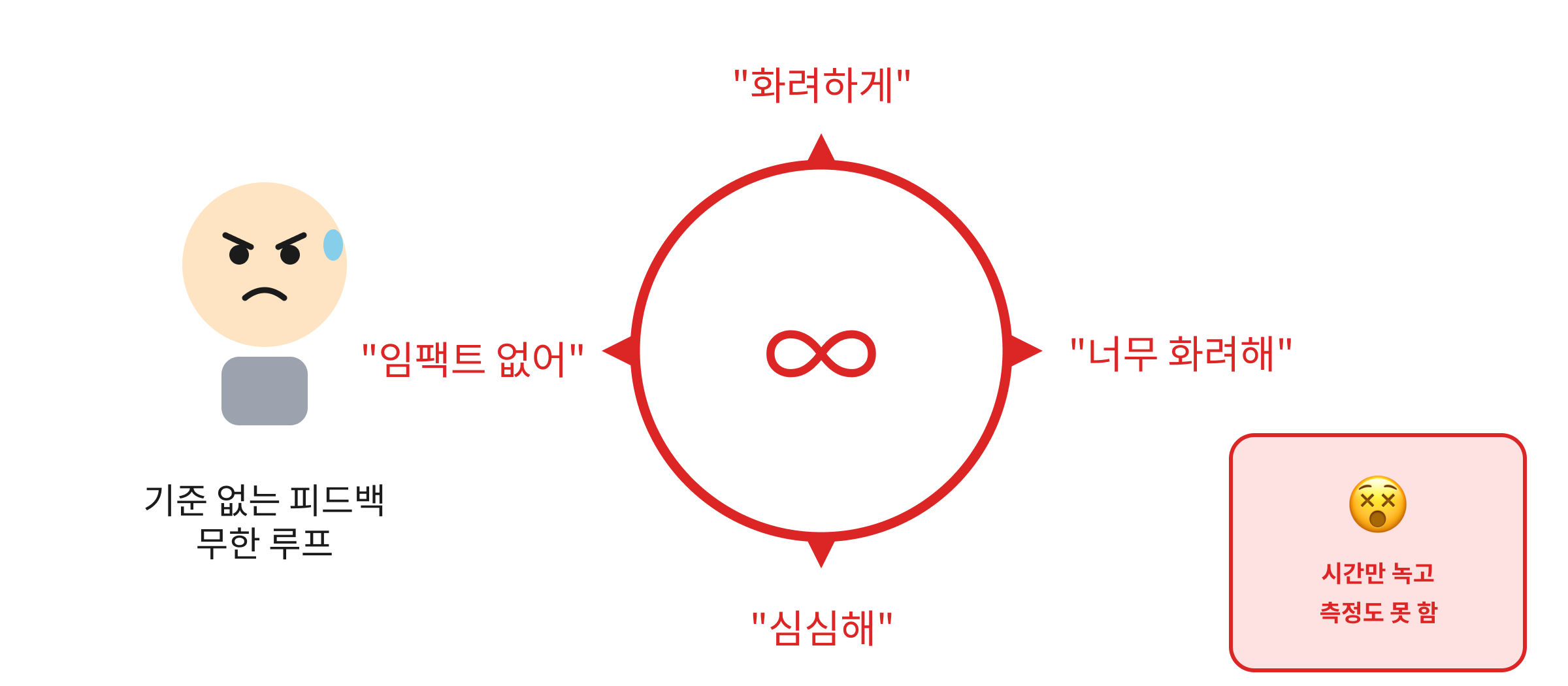
So Here's How Softly Does It
In this post, I'll explain how Softly looks at design and how we give feedback. It's worth reading before an interview.
Everyone's Standard for "Clean" Is Different
You've probably heard feedback like this in a design review, right?
- "Make it a bit prettier."
- "Can you clean this up a little?"
- "It doesn't have the right feel."
- "Something's just missing."
What do all of these have in common?
There's no standard.
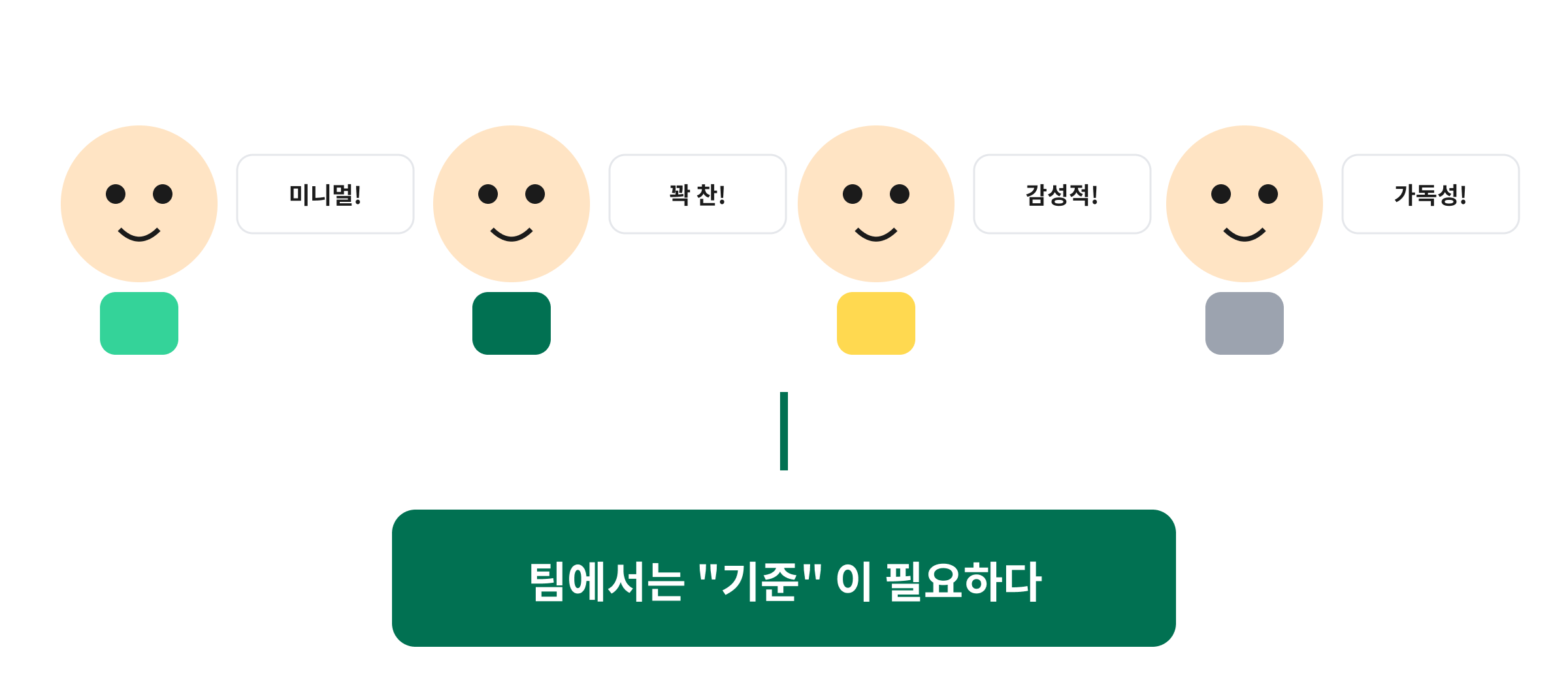
They're all valid comments. But on a team, you need a shared "this is what we mean by pretty." Only then does feedback like "make it prettier" turn into a concrete action.
What Is Good Creative?
So what is "good creative"? Here's Softly's definition:
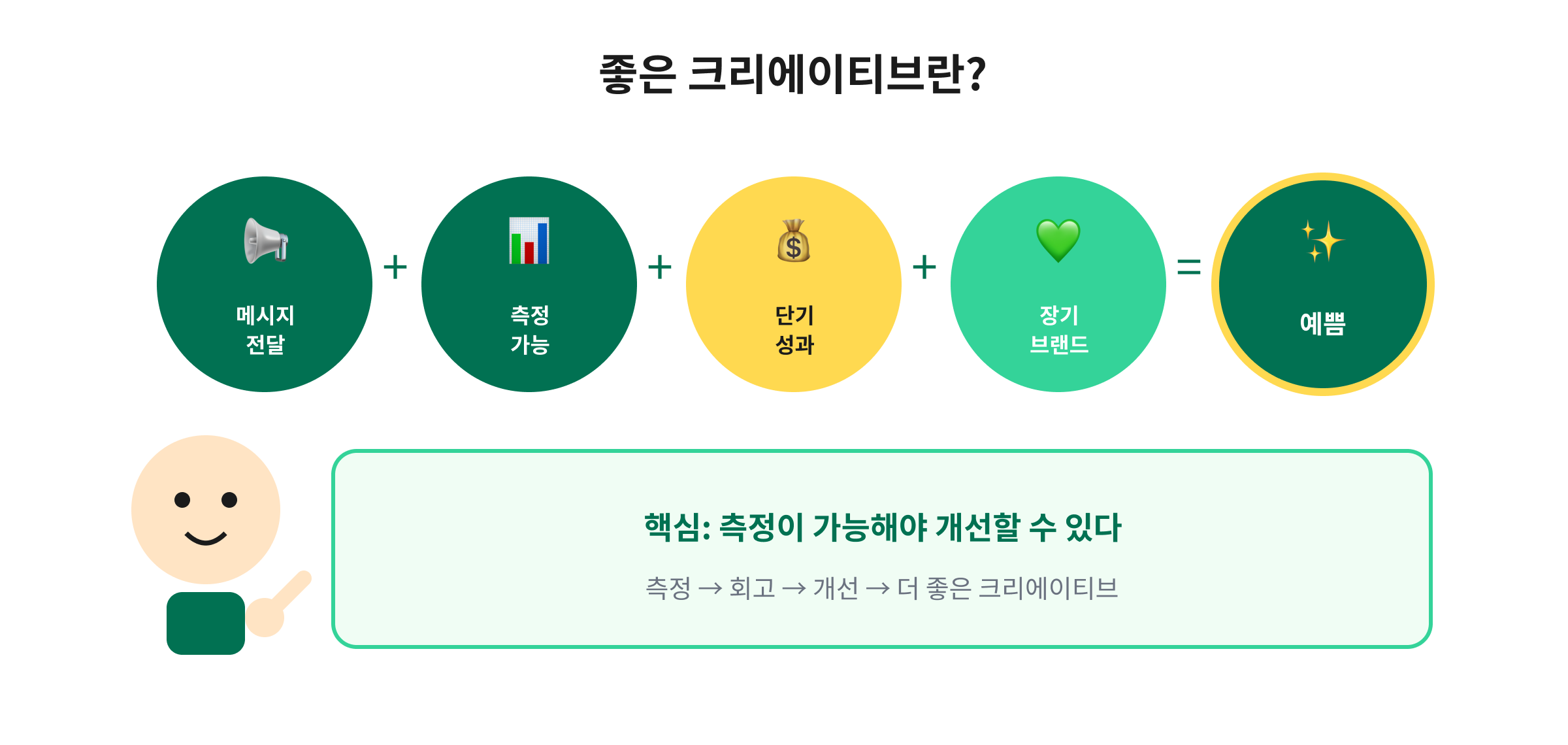
The Key: You Can Only Improve What You Can Measure
No matter how pretty a design is, if you don't know "whether it worked," you can't do better next time.
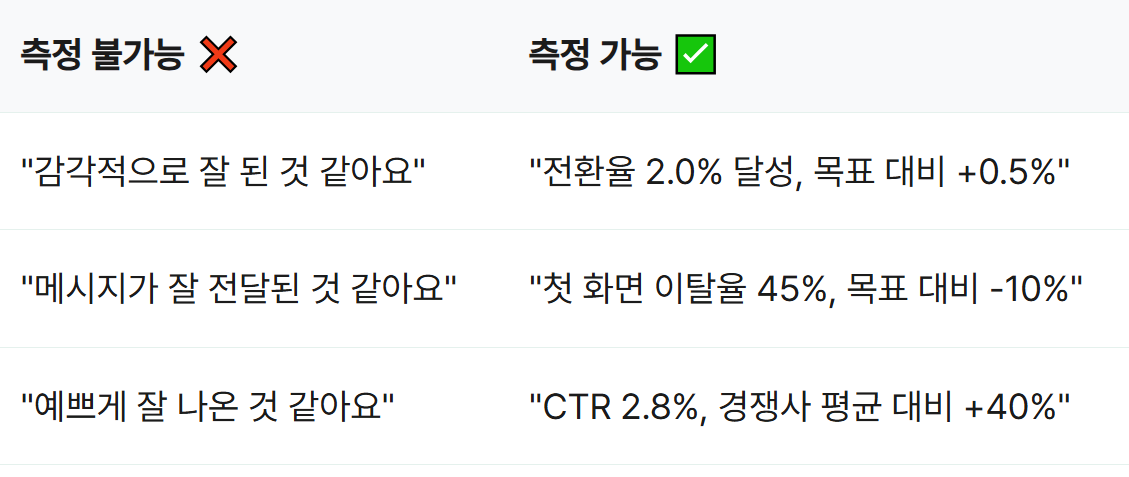
Only when you can measure can you:
- know "what worked well this time,"
- know "what to do better next time," and
- build up "your own standard."
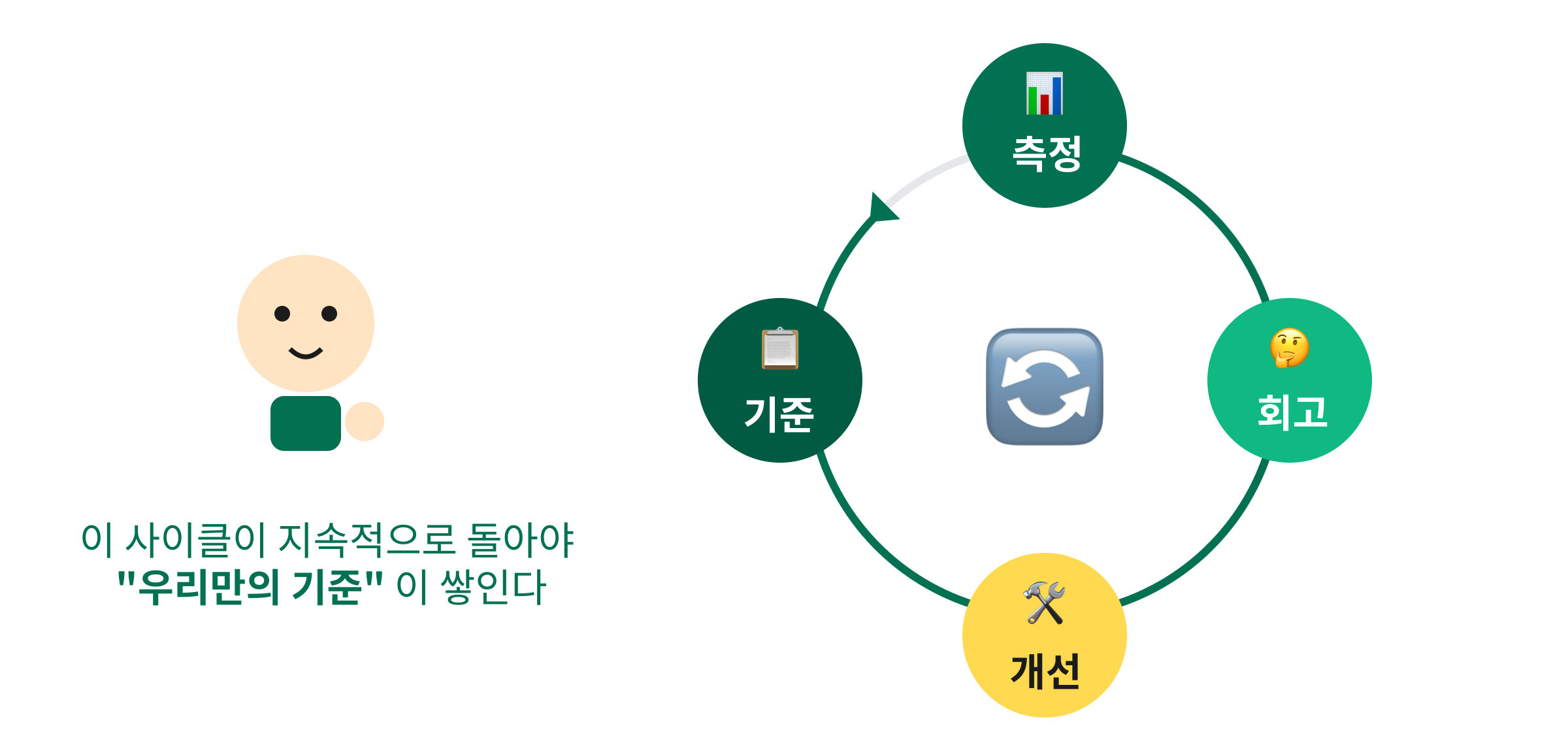
The Measure → Retrospective → Improve Cycle
Let me show you an example of how we actually do this.
Example: Runiel Detail Page
Step 1. Measure
- Click-through rate (CTR): 0.4%
- Conversion rate (CVR): 3.21%
Step 2. Retrospective
- Problem: The conversion rate seems a bit low. Among products in the same category sold on Coupang, some reach a CVR of up to 8%, so let's aim to get there.
- The point that's dragging conversion down might be that the message isn't landing well in the first top section. It felt like the layout wasn't clean.
Step 3. Improve (Try)
- Let's enlarge the image area in the layout so it's clearer what product we're actually selling.
Step 4. Re-measure
- Click-through rate (CTR): 0.39%
- Conversion rate (CVR): 5.62% ✅ (a 2.41%p improvement)
Step 5. Further retrospective and setting the standard
- Problem: CTR barely changed. The thumbnail itself has no problem driving clicks; it was the improvements inside the detail page that contributed to the CVR increase.
- Setting the standard: "For Runiel detail pages, make the product image large on the first screen and keep the message concise."
- → Apply to the next creative
Two Perspectives: Commerce vs. Brand
When evaluating whether a message lands, you need two perspectives too.


Why You Need Both

How to Define Our Own "Pretty"
"Pretty" or "beautiful" is an abstract concept. At Softly, we define it in the context of quantitative measurement.
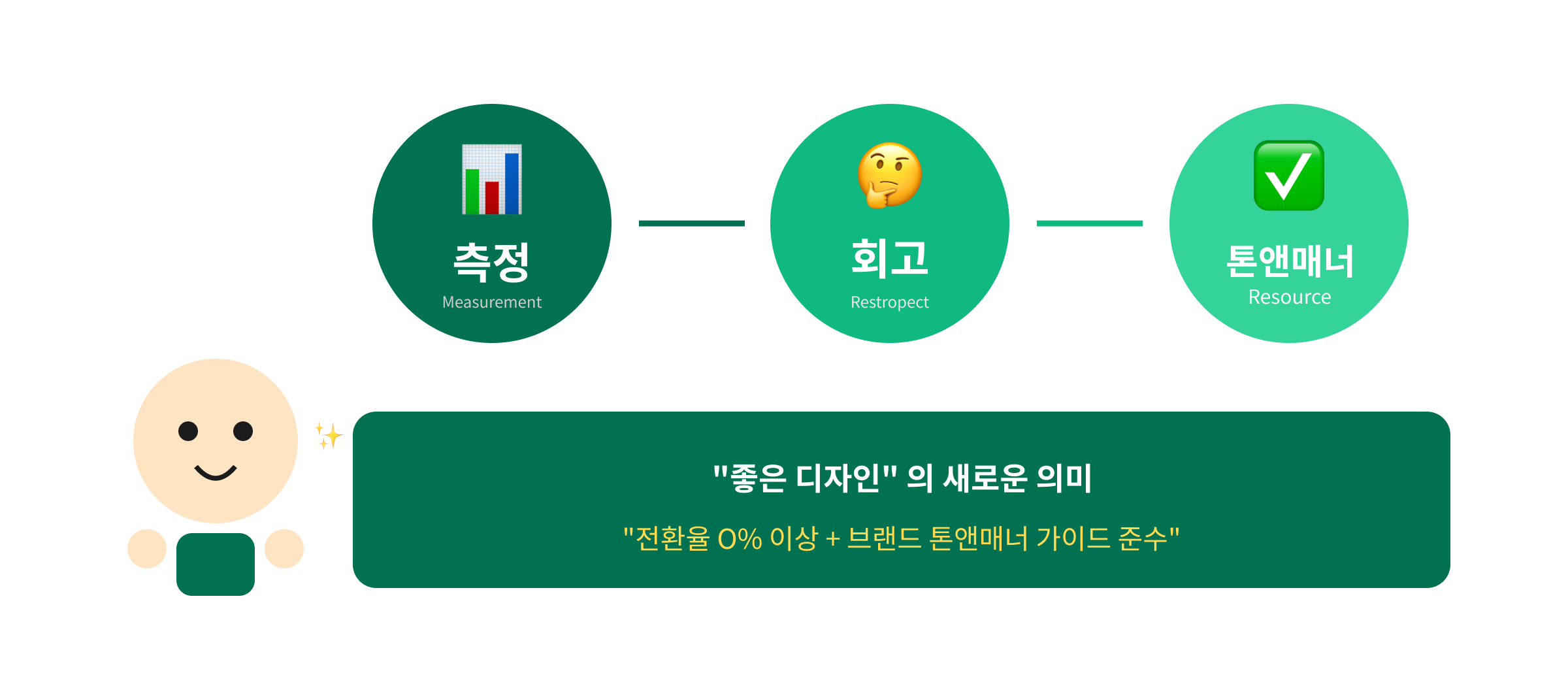
How Runiel's "Pretty" Was Defined
1. Measure: A/B test of Option A (minimal) vs. Option B (information-focused) → Option B conversion rate 1.8% (Option A 1.2%)
2. Retrospective: "Runiel customers want information before emotion."
3. Brand check: Did Option B still keep the sage green tone and manner? → Yes ✅
4. Setting the standard: "Runiel's pretty = information-focused + sage green tone"
The Three Areas of Softly Design
At Softly, design is broadly divided into three areas. The standard for "good creative" is a little different in each.
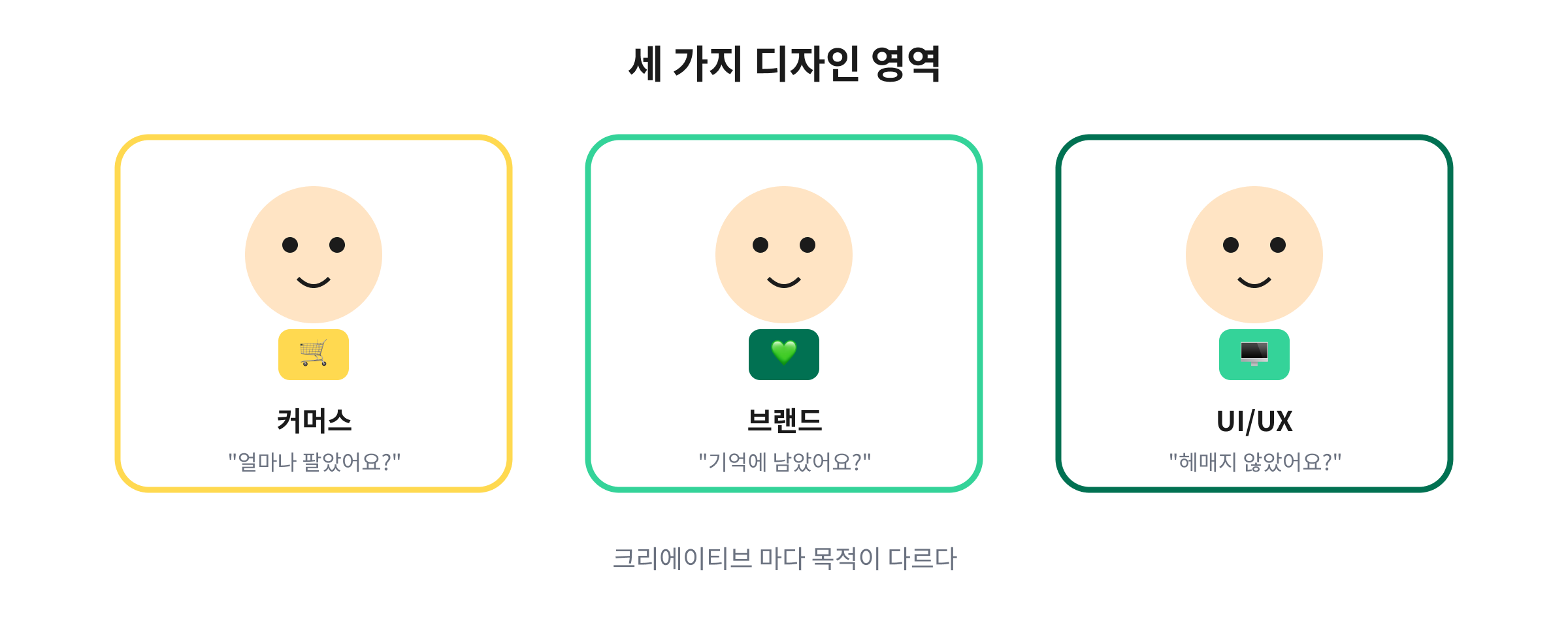
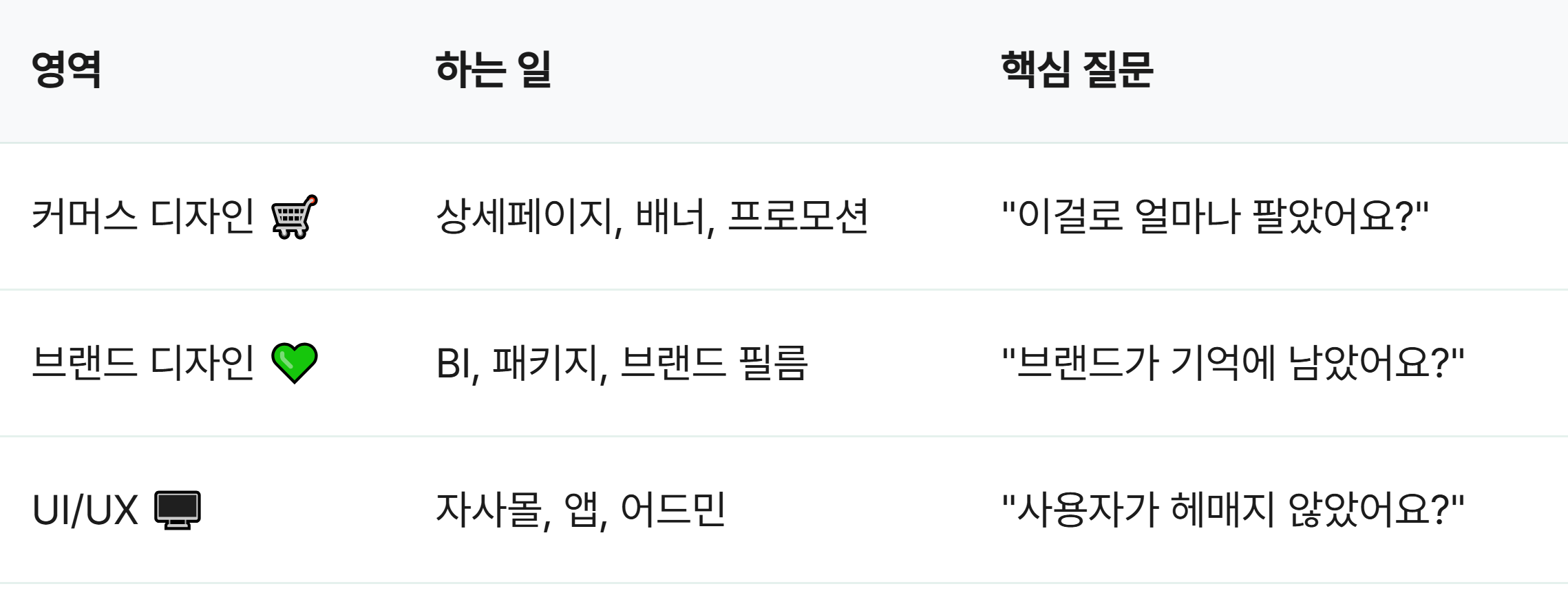
The weight of the two lenses differs by area. Commerce design leans heavily on short-term performance, while brand design leans heavily on long-term brand. But neither is ever zero. You always have to consider both.
Feedback Is a Retrospective Too — Keep, Problem, Try
"Make it a bit prettier." This feedback isn't connected to the definition of "good creative."
- Does it mean improve commerce performance?
- Does it mean improve brand consistency?
- Both?
You can't revise it because you don't know.
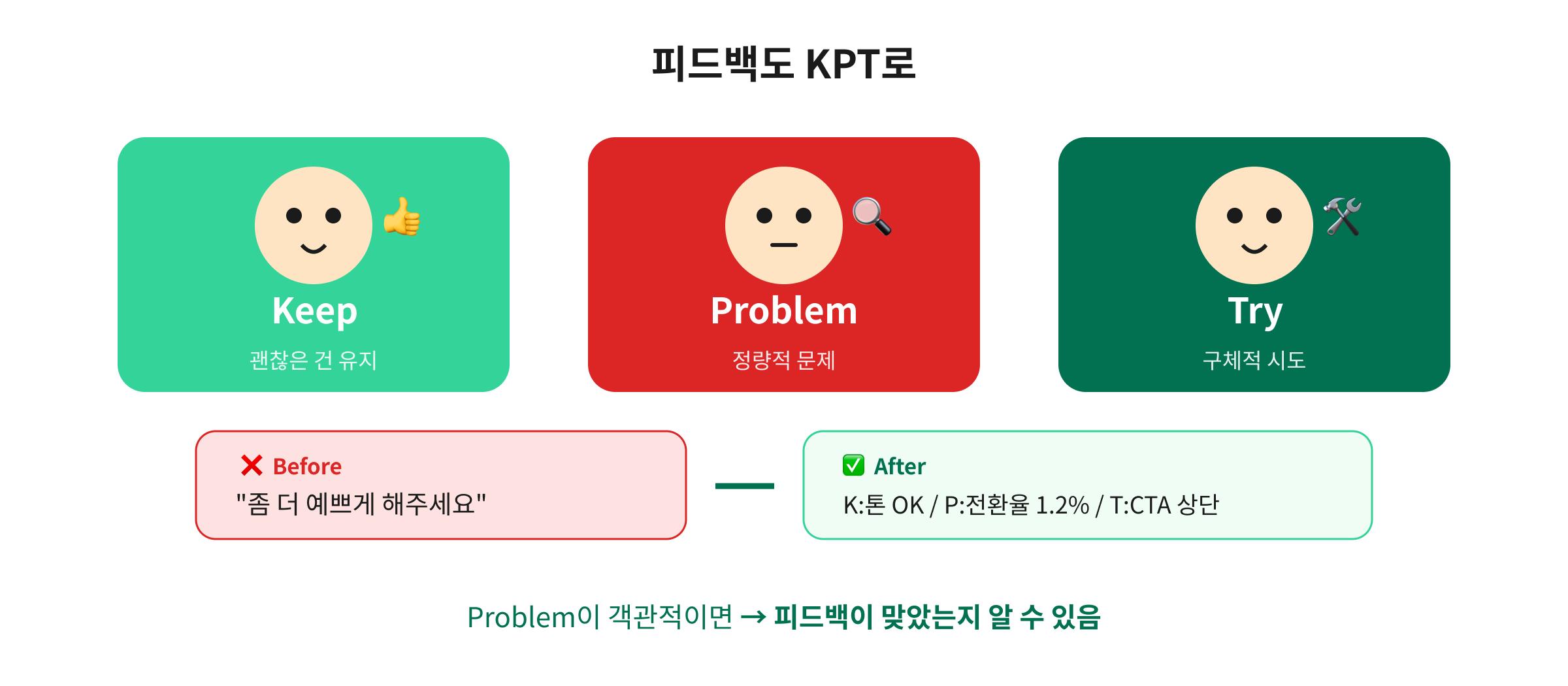
Before vs. After
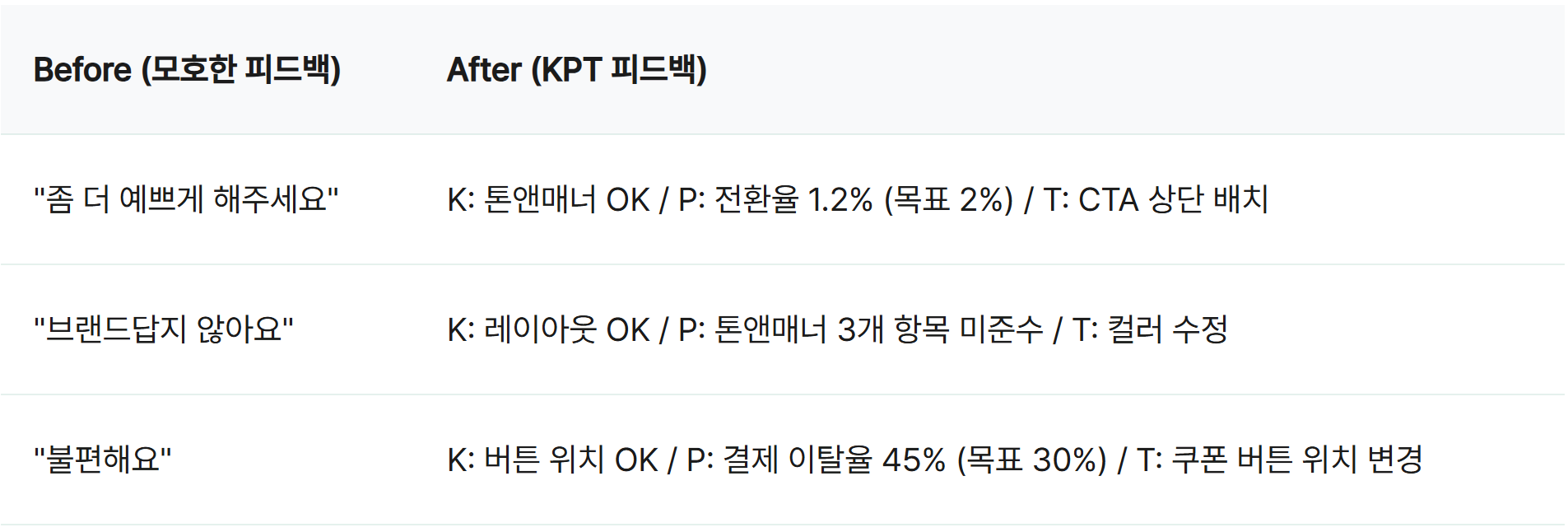
The Key: The Problem Must Be Quantitative
What We Check in Interviews
I've put together some of the questions we often ask in Softly designer interviews. I'll tell you what we want to confirm with each one and what makes a good answer.
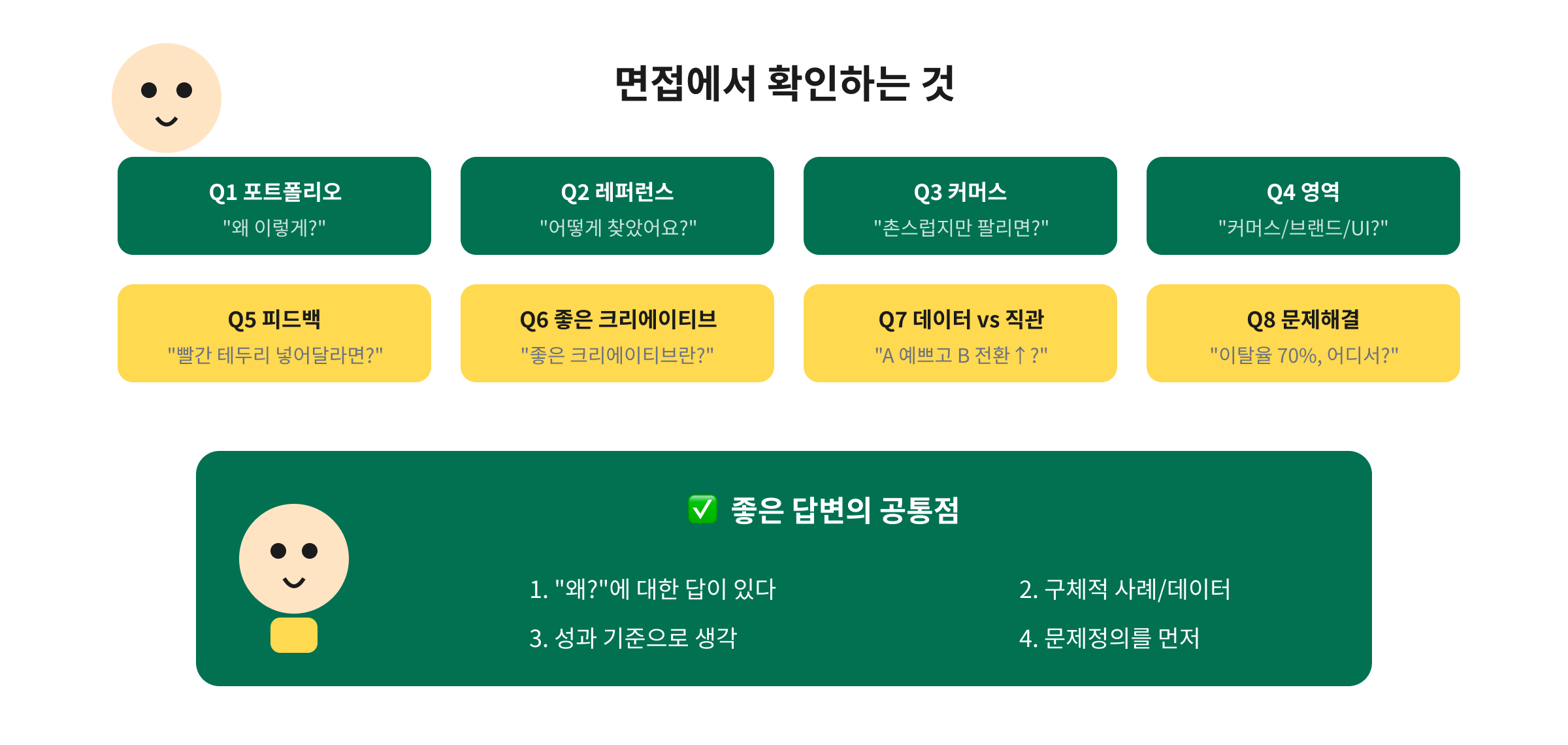
Q1. "Why did you design this detail page in your portfolio the way you did?"
What we want to confirm: Is there a logical rationale behind the design decision?
❌ Common answer
"Because it looks pretty."
✅ Good answer
"I referenced the information → benefits → CTA order from the No. 1 detail page on Naver Shopping."
Q3. "Have you ever seen a detail page that feels 'kind of tacky' but sells really well?"
What we want to confirm: Do you understand that "pretty ≠ sells"?
❌ Common answer
"Not really."
✅ Good answer
"Coupang's Homestar detergent. The design isn't sophisticated, but the familiar colors and the information you can take in at a glance seem to be why it sells well."
Q5. "What if someone says, 'Add a red border, make the font bigger, and put in a discount-price badge'?"
What we want to confirm: Can you ask "Why?" Can you propose an alternative?
❌ Common answer
"...Sure, I'll do it."
✅ Good answer
"I'd ask first why it needs to change that way. Whether it's a conversion-rate issue or a CTR issue, the direction of the fix would be different."
Q7. "Option A is pretty but converts at 1.2%; Option B is tacky but converts at 2.0%. Which do you pick?"
What we want to confirm: Are you curious about "why the difference happened"?
❌ Common answer
"Option B." (with no reason)
✅ Good answer
"Option B, but I'm curious why the difference happened. I'd analyze it so that next time I can make a design that's both pretty and high-converting."
The Ideal Designer, as Softly Sees It
If you gather up what we want to confirm through these interview questions, you get a picture of the ideal designer as Softly sees it.
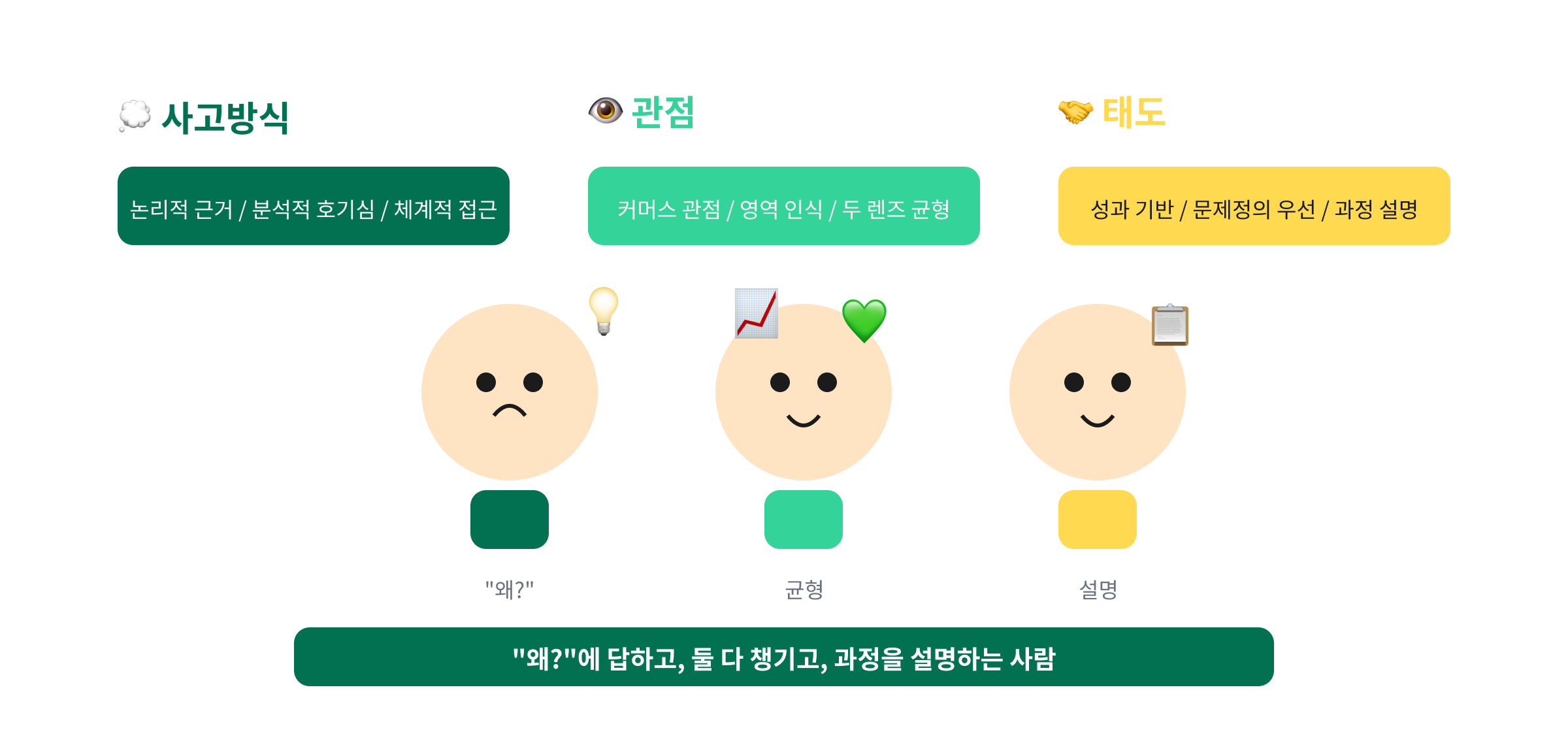
Nine Competency Elements
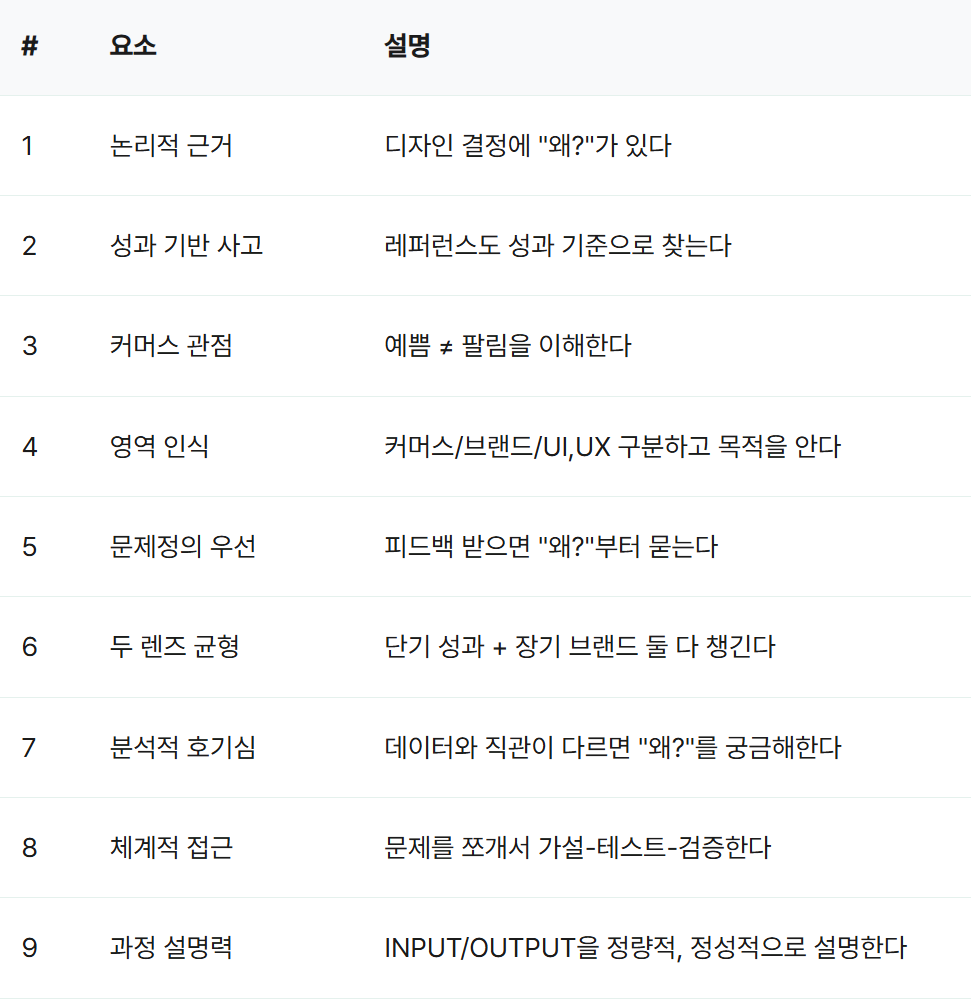
Asking for Too Much, Aren't We?
If you've read this far, you might be thinking, "Isn't this company asking for way too much?"
Honestly, we don't have all nine of these perfectly either. Softly still has a long way to go. We're constantly refining our measurement system, and we're working to get better at our retrospective culture. We're still building up each brand's standard for "pretty," too.
So this post isn't saying "we'll only hire people like this." We want to share the direction we're aiming for and find people who resonate with this philosophy. We want to fill in the gaps together.
Self-Assessment Checklist
The more of these you can answer "Yes" to, the more likely you are to be a good fit for Softly.
- When someone asks "Why did you do it this way?" about my design, I can explain it logically.
- When I look for references, I analyze "why did this work?"
- When I see a tacky but well-selling design, I'm curious about the reason.
- I can tell whether my work is commerce, brand, or UI/UX.
- When I get feedback, I can ask "Why?"
- I think both short-term sales and long-term brand matter.
- When Option A is pretty but Option B converts higher, I'm curious "why the difference happened."
- When a problem comes up, I start from "where's the problem?" rather than "let's just change everything."
- I can explain my design process (INPUT/OUTPUT) both quantitatively and qualitatively.
Whether you have many Yeses or few, if these questions felt like "good questions" to you, you could be a good fit for us.
Closing
Here's how Softly thinks about design.
Of course, we're not doing this perfectly either. There are still many areas we haven't managed to make objective, and we're continually improving our measurement system. But the direction is clear. We're constantly trying to make things more objective, and we'll keep doing so.
The purpose of this post is one thing.
"We want to work with people who look in the same direction."
If you resonate with this philosophy and want to build the standards together, reach out anytime.
— From Grady
If this design philosophy resonates with you
Apply to the Design Family